
What’s in a badge?
How to design an event from first principles: a detailed case study

In the days after Progress Conference 2025, political analyst and think tank leader Daniel M. Rothschild had an X thread on the badges at the conference that our not-for-profit, the Roots of Progress Institute, had organized:
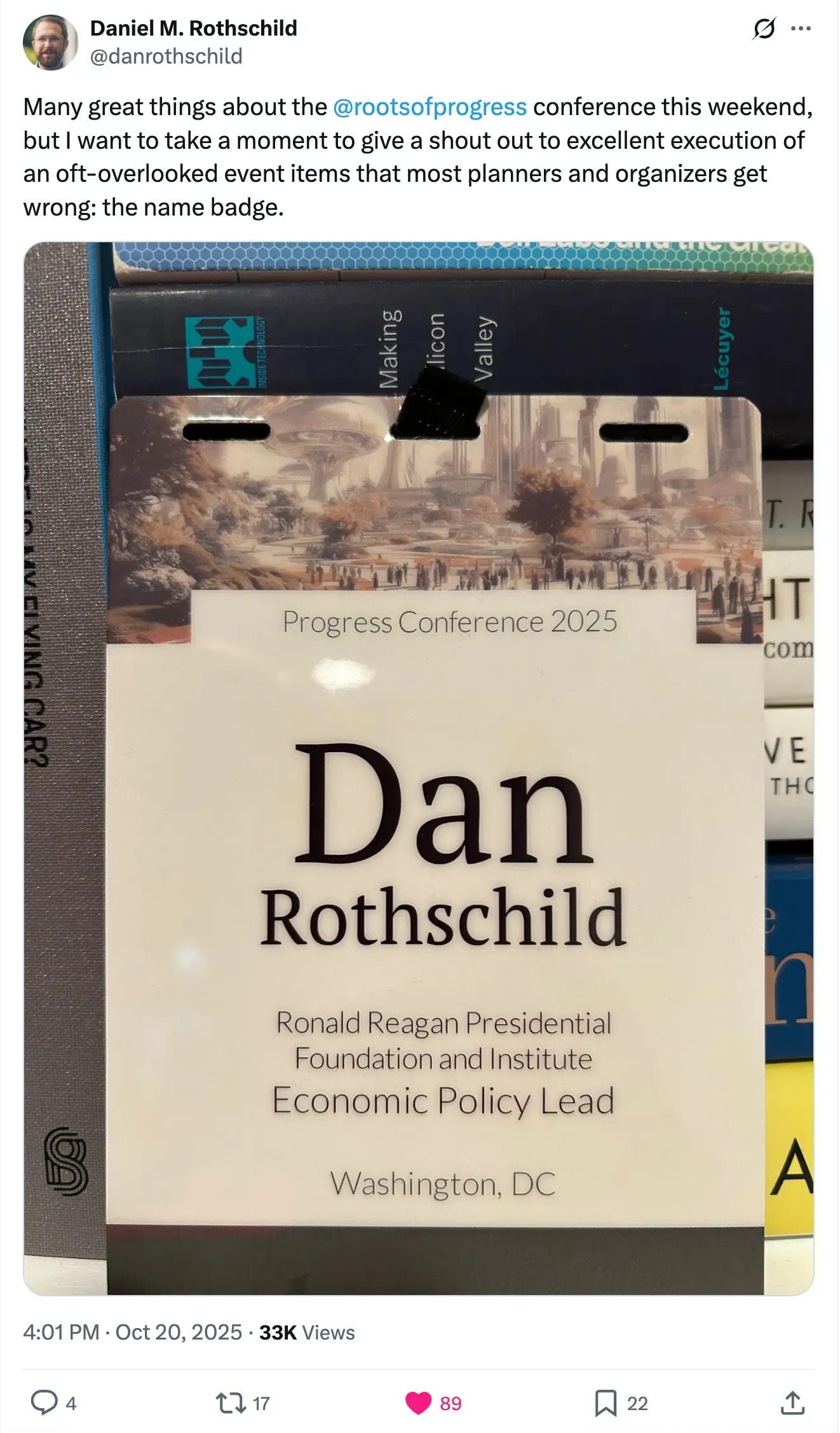
This thread made me happy, because I felt seen. Other posts also identified just what made this event special Ruy Teixeira, American political scientist and commentator at the American Enterprise Institute, highlighted how the conference showcased what makes the progress movement unique, from the political diversity of the attendees, to the entrepreneurial bend and the “generalized techno-optimism [of] the crowd that far surpassed what you see in Democratic-oriented abundance circles”—something that Andrew Burleson, co-founder of Strong Towns, called “Pragmatic Optimism.” As psychologist Adam Omary from Human Progress put it:
[t]he Progress Conference was filled with an atmosphere of optimism and ingenuity that is sorely lacking in most places. Human flourishing is ultimately measured not just by material comfort or technological advancement but by psychological well-being and a sense of purpose. It is inspiring to be surrounded by people who believe in progress and want to do their part in contributing to the betterment of our society and our species. How much better would life be if we all did that?
A good event is one that achieves its goals. The annual Progress Conference has four goals:
Meet great people • Catalyze new projects • Share ideas • Be energized & inspired
Everything about the event was designed to support these goals. Badges, invite list, talk topics, event structure—all are downstream from the big question Jason Crawford, RPI’s founder, and I asked ourselves in January 2024: Why do we want to organize an event for the progress community—and what does a great event for this group of people look like?
I remember being quite intimidated at taking on this task. After all, neither Jason nor I had ever organized an event larger than our own weddings. We had both been to many conferences that were a waste of time. Inviting even 100 (never mind now close to 400!) of our heroes to spend 20+ hours somewhere is a huge responsibility: 400 x 20 = 8,000 hours of some of the most productive and innovative people in the country is a significant investment (much more than, say, a $300k conference budget!).
That’s why I was so relieved and proud when on the first day of the first Progress Conference people started coming up to us, and sharing that it was one of the best events they ever attended, and congratulating us on the event when it had barely started.
Maybe part of our success here is due to our lack of experience, which made it easier to just start from scratch and design the event around our goals. I guess you could call it a first principles approach to event planning: all of our decisions were downstream from identifying our goals.
In this post, I’ll highlight how this played out in just a few examples of decisions we made. Nothing here is rocket science (although it’s cool to have real-life rocket scientists tell us they got value out of our event!).
The tl;dr: Apply product design ideas to event design: think deeply about the problem you want to solve with your event—and then design a solution around a clear problem statement. I loosely had the double-diamond product development framework in my mind—although the problem-solution exploration happened in a more overlapping way than this ideal counsels us to do.
The research phase: from idea to conference goals
For a couple of weeks in early 2024, I just interviewed people in our broader community and asked them lots of questions: What are you missing as you think about our community, and especially the value of meeting people? What was the best in-person event you’ve attended—and what made it special? Who runs the best events? What mix of people would be good to bring together? What do you hate about poorly run events—what are your pet peeves? If you’ve run events, what operational mistakes have you made—and do you have any checklists we can borrow? In addition to open-ended questions, we also sent out queries about specific things like venue ideas and event management partners.
We solicited and received great advice from many people who haver run a wide range of events—including the Effective Altruism community which has been running successful EA Global events for years, Tyler Cowen and the Emergent Ventures team who have been running unconferences, Michael Nielsen, who has facilitated workshops that received much praise, the team at Foresight Institute whose Vision Weekends have been mainstays and models for great events, and others.
The research by several people in our community on the value of in-person gatherings was also super helpful in identifying what type of in-person encounters actually have a positive impact, and how.
Matt Clancy had a great post three years ago on the value of academic conferences for collaboration. The key insight for us: Conferences are valuable if they bring together people who have some meaningful overlapping interests (not too similar, not too different), and if the events are structured so that people who don’t know each other yet spend meaningful time engaging with each other (not just attending talks, but a way to interact on a topic).
Eric Gilliam, on Freaktakes in late 2022, had a write-up on how Feynman thought about scientific conferences. He shared anecdotes of early conferences attended by people from across disciplines in physics that Feynman thought were tremendously valuable, and contrasted them with the bigger, more specialized/siloed conferences of later years, which Feynman thought were much less valuable.
All of this set the context of how we think about the role of the Progress Conference in our movement. We’re a movement centered around cross-disciplinary ideas, with a focus on actually applying those ideas (more applied medicine than pure research, as Tyler Cowen and Patrick Collison put it in their 2019 Atlantic article, which is a bit of a founding document to our movement). An in-person gathering should bring together thinkers and builders interested in why and how progress happens, across disciplines and fields, expose them to ideas in related areas, enable them to meet each other in real life, and give them time to discuss ideas deeply enough to learn to trust each other and allow new projects to be born.
That’s the context for the four goals on our conference page:
Meet great people = a diverse set of people thinking about progress and building toward it—people who don’t already all know each other within a discipline or location
Share ideas = expose people to ideas in progress studies that aren’t in their area of expertise, so ideas can cross-fertilize
Catalyze projects = create an environment where people who may benefit from working together but don’t know each other can meet, so new things can be born
The last part, Be energized and inspired, wasn’t something that explicitly came from the interviews or the research. I think it’s more of an outflow of our experience with our blog-building intensive in 2023: both Jason and I were amazed at how powerful it was for our fellows to meet in person in San Francisco—how much energy and inspiration came from that in-person gathering, and we wanted to replicate that at a much larger scale.
A personal side note for other Type A personalities: I find myself struggling with this phase every time I set out to define a new program or product. It feels so non-productive. I’m talking to people, taking notes, thinking—but not actually (yet!) creating or building anything. That feeling is always there, even as I know that this thinking is essential to creating anything worthwhile.
My key message here: don’t skip this work. Take it seriously and do it as systematically as you can, but do allocate an appropriately meaningful amount of time to it.
Problem definition matters—it’s worth the time and groping effort!
The design phase: from goals to event announcement & invitation list
Putting an event together means making countless decisions: Who should we invite—and how do we create an event that makes those people excited to come? Where should the event be—which city, and which specific venue? When should this happen—what month, how long, and what days of the week? What should happen at the event—how many talks vs. unstructured time; what should talks be about, how long should they be?
Having clear goals helps—as does having taste in events from experience. Dan’s thread on badges is a great example: read it with our goals in mind, and it’s clear why our badges are important and designed the way they are.
I’ll just play out our decision-making on one topic, getting “great people” to the event, to illustrate how being focused on specific goals helps with deciding on this both early in the planning and then later on at a tactical level.
Who do we want to come to the event?
This question has multiple levels.Should we even select people, or just let people buy tickets?
Some events just advertise and sell tickets, trusting that participants will self-select. For us, the quality and mix of people was critical: we wanted to create an environment where, as Jason put it in his opening remarks, “everyone here could have been a speaker and run a compelling session.” We wanted attendees to feel confident that any random person they talked to would be someone they’d respect and who had something meaningful to contribute to the discussion. So it was clear from the get-go that this would be an invitation-only event.If we select, what type of people do we want to come?
Progress Studies is an interdisciplinary project. It was critical to the event’s success to have people come from a wide range of backgrounds. As we put it on the website, participants would meet key academics and public intellectuals, leaders of progress-related organizations, founders and engineers working to build an ambitious future, cultural leaders from YouTubers to SciFi authors, our RPI fellows, and supporters of the movement, including our conference sponsors.
We were also clear that we were excited to have people from all the flavors of the progress movement:
”Whether you identify as a supply-side or abundance progressive, e/acc or EA, whether you come at progress from a classical liberal background or study meta-science, advocate for broad YIMBY or American Dynamism—you are invited to meet each other, share ideas in unconference sessions, and leave energized.”How do we identify specific people who meet these criteria?
Part of this was easy: Jason Crawford, RPI’s founder, has, through his writing and intellectual work, built up a network of people who respect and know him. So the start was to invite those people.
But we were also aware that this wasn’t a complete list. That’s why we turned to our co-hosts—aligned organizations who partner with us on the conference—to ask for their recommendations. Our co-hosts are a group of progress-aligned not-for-profits who bring insights and access to different parts of the progress movement, from cutting-edge science and tech (Foresight Institute) to policy (Institute for Progress, Foundation for American Innovation, Abundance Institute), to progress education (Human Progress), to academia and research (Institute for Humane Studies) to progress writing/journalism/publishing (Works in Progress). With their breadth of context, they added people to our list.
And still, we knew this wasn’t enough: even combined, we couldn’t possibly know all the great people who should come to the conference. Also, an event like this can help people signal that they are part of the movement and discover and join it. So we created an open application process for about a quarter of the tickets: people filled out a Typeform survey, sharing a bit about their background, why they wanted to come to the conference, and what they would contribute to the discussion. The result? We received several hundred applications in 2024, and over seven hundred in 2025, many of whom no one in our organizing group knew, but who were great fits for the event.
It turns out there are many more people excited about the progress movement than any of us know!A little detail on the open application. We knew we’d overlook some obviously great-fit people in our invitation list, people who might think, “Why didn’t I get an invitation in the first place?” So our application has a first, required part, where you just enter your name, org, and link to your bio/website. You can end the application right there, or you can continue to answer all the questions. This made it easy for the “why didn’t you think of me?” people to just quickly remind us that we should have invited them, and it gave others whom we just didn’t know the opportunity to tell us who they were, and why they were a great fit for the event.
How many people should we invite?
When we first drafted our “why a Progress Conference” one-pager back in early 2024, we set a goal of 100-150 people. We were pretty confident that we knew enough people who would be great and could convince that many to come to a new event—and that 100-150 would be a sufficiently large group to meet our goals.
Turns out (see below) that there was a lot more qualified interest. Our first event was sold out with well over 200 people attending and a waitlist. This year, we expanded to 375 people—and still turned away well over a hundred people who would have been great participants.Should we charge for tickets—and if so, how much?
We debated that topic quite a bit with our co-host organizations early on. On the one hand, we didn’t want cost to be an issue keeping people away. But also, we had a hunch that this event might sell out—and we wanted to reduce the risk that people would grab tickets and then not come. So we decided to charge admission that covered a good share of the variable costs of the event, but to also offer scholarships and even travel support for great people we wanted there but who couldn’t otherwise attend. To make up for reduced-price and full scholarship tickets, we also offered more expensive supporter tickets—and it turned out a good number of people were willing to pay more to enable others to come.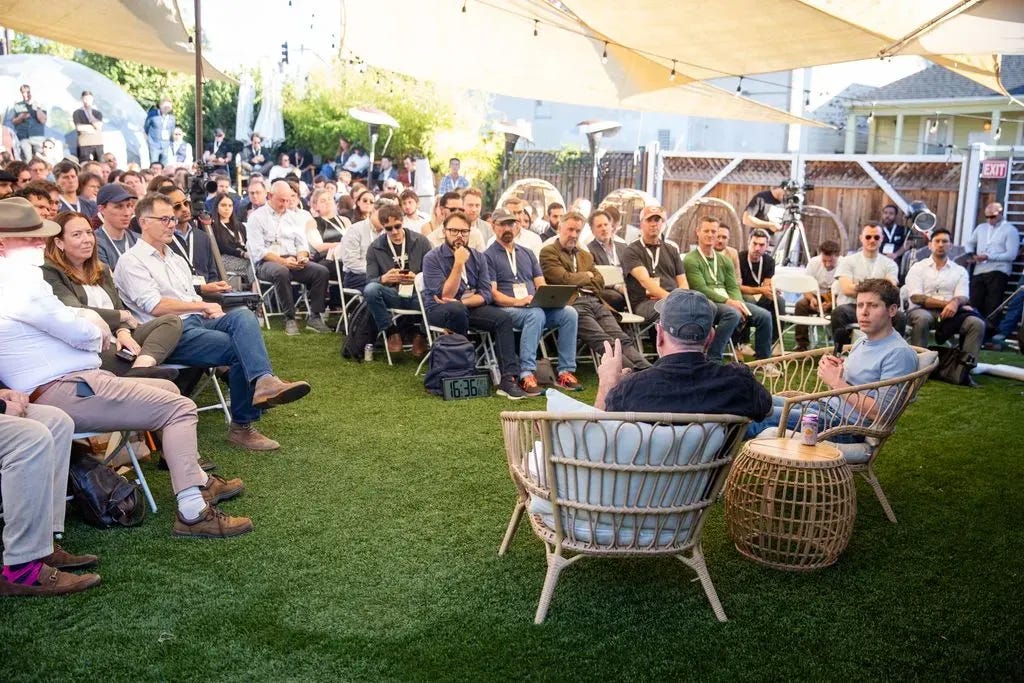
How do we get these great people excited to come to the first conference?
When you start a new event, it’s not a given that it will be well attended. There are so many bad conferences that many people are skeptical of investing 3+ days with travel, and rightly so. And while there wasn’t yet in 2024 a central event for the progress movement, there were several good adjacent events, including Breakthrough Institute’s regular conferences, the Foresight Vision Weekends, and FAI’s galas and events. There were also many specialist events, such as StrongTowns’ annual gathering and YIMBY Town for housing people/YIMBY/urbanism. We needed to create an event that was differentiated and make its value clear to people.A great slate of speakers. We were able to get a commitment from a dozen exciting speakers covering different parts of progress before we announced the first event—including Tyler Cowen, Eli Dourado, Julia deWahl, Virginia Postrel, Brett Kugelmass, and others—a high-quality list that showcased the quality and diversity of people who would be at the conference.
A program that highlighted the breadth of topics. This conference wasn’t going to be just about policy; it wasn’t going to be a VC+start-up event; nor was it going to be an academic conference—all of which already exist! Our goal was to create an interdisciplinary event, so we made sure our talks and topics ranged widely, from big ideas in history and economics to specific technologies, to storytelling and policy.
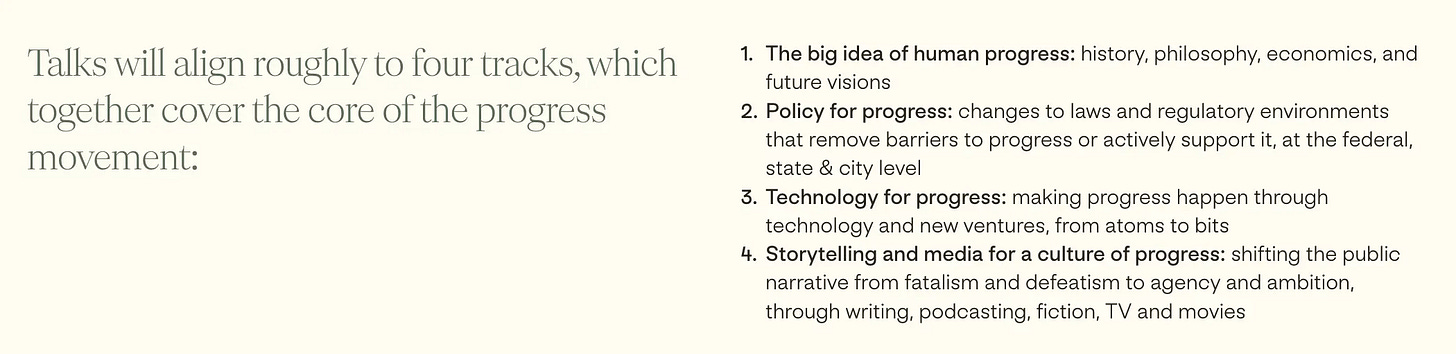
The topic section from the 2024 conference website
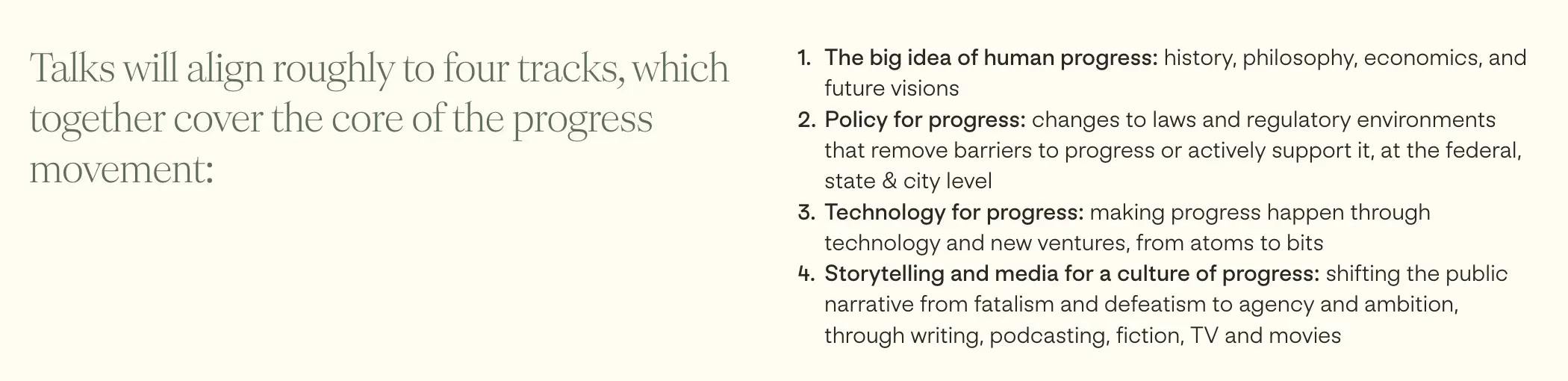
We pre-announced the conference with a scrappy Notion page in April 2024, and actively worked to get great people to attend. The pre-announcement also invited people to volunteer to speak. By the time we publicly launched the event website in June, we had about two dozen great speakers—and were confident in having 100+ great attendees. With this momentum, it was much easier to get tickets sold and to make the open application compelling.
Of course, getting the right people there is only part of the magic (albeit a big part!) Once they are there, they have to meet—and we put just as much thought into that as into the invitation list.
The badge thread I mentioned above is a great example. Dan points out specific things that made the badges work—being double-sided, a good lanyard, no safety pin, the first name in super large font, and an attractive design. I’d also add that badges being solid plastic and not card stock mattered, as it made them durable enough to look nice all through the event.
Dan explains perfectly why and how badges matter for the type of event we wanted to host:
Why does all this matter? Because the best events are those that are designed to facilitate maximal interaction and introduction between people (and to meet IRL people you know online). That’s the case with unconferences, or events with a lot of social/semi-planned time. If you plan a great event, invite all the right people, have a killer agenda, and then provide name tags that people don’t wear or are optimizing for aesthetics (or worst, cost savings) rather than utility, you’ve immediately destroyed a ton of value. Seriously, you could destroy six figures of value in many rooms with the wrong name badges. I am not exaggerating. They are that important. If your event is designed for people to listen to talks and not really substantively interact (”Hi, my question is really more of a statement...”) then badges don’t matter. But for the best events they are perhaps the most important items after venue, participants, and schedule. My weekend was at least 30% more productive than it would have been in the absence of these excellent name badges that @jasoncrawford and @HeikeLarson designed. So thank you Jason and Heike, and I hope others will follow your example! Badges can’t be an afterthought.
“Meet great people” was a guiding goal that shaped other aspects of the event, too. Here are just two of many examples:
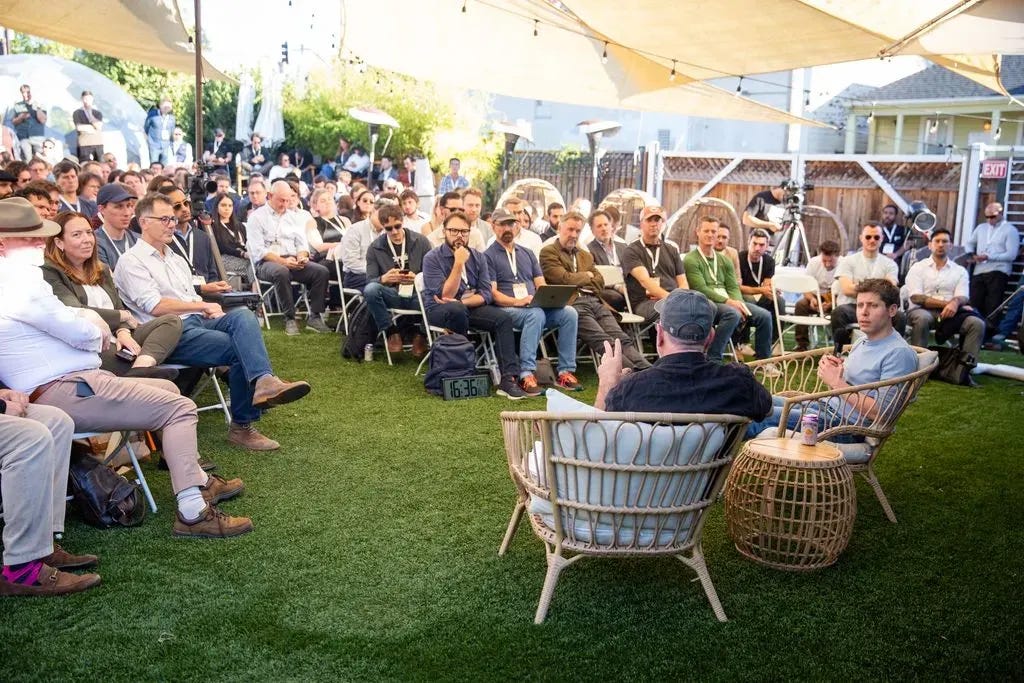
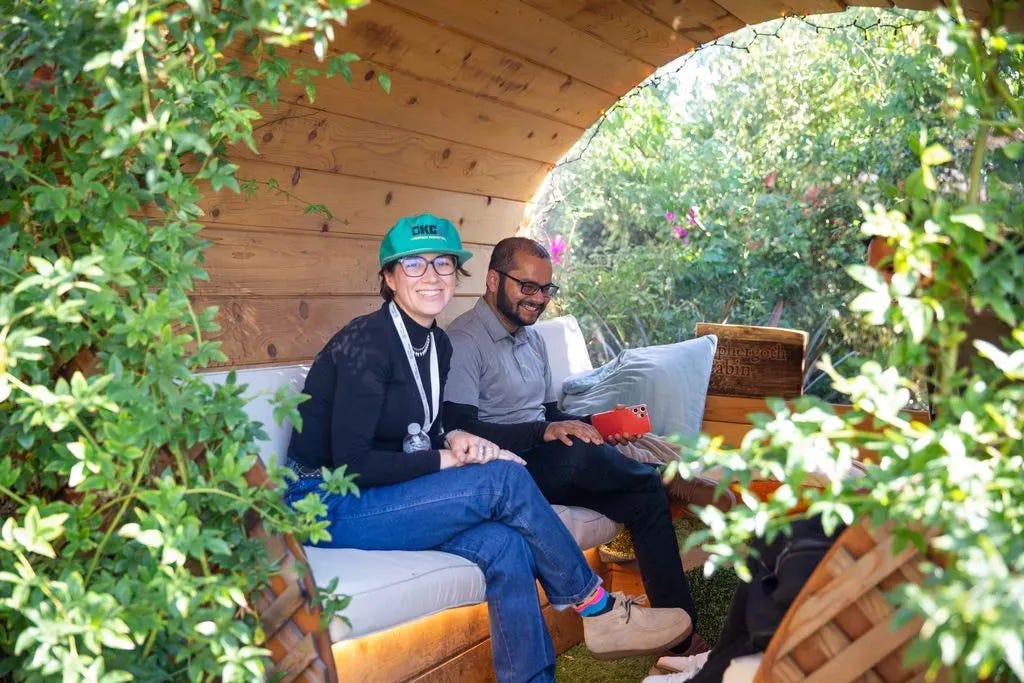
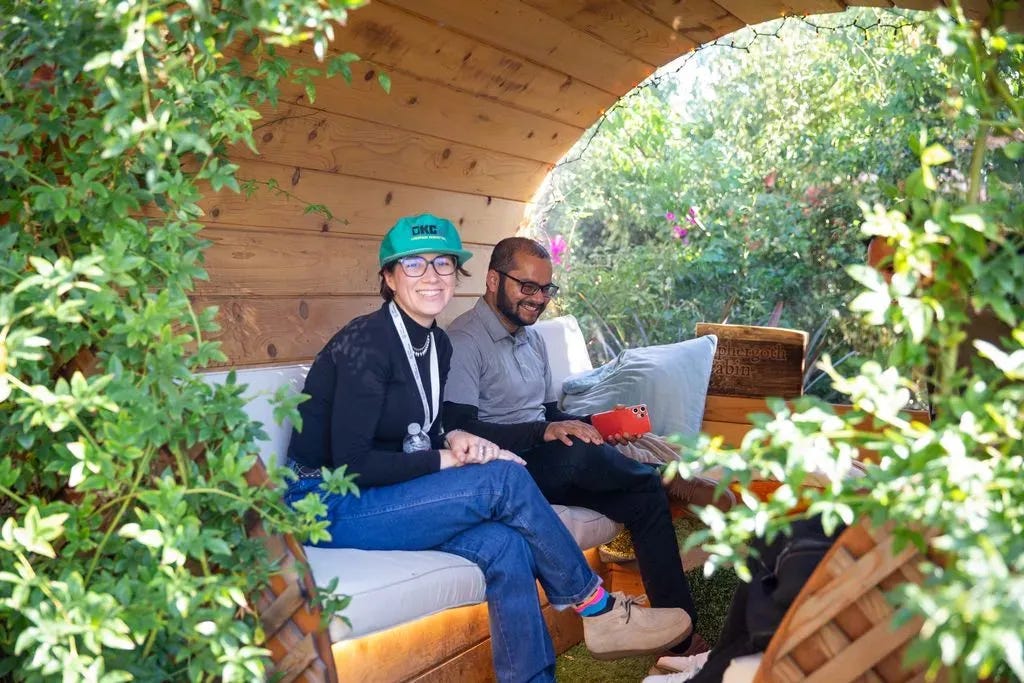
Venue choice. We chose Lighthaven for many reasons, but mainly because it is such a great setting for serendipitous and planned encounters. Even the bugs are features: there’s only one large outdoor space that fits several hundred people. So most sessions are smaller (20-80 people). This means that outside of a few plenary talks, a large share of attendees are by necessity in the Garden Track, just meeting and talking and going deeper on the many topics explored in the sessions. Plus, it’s much more energizing (goal #4!) to talk outside in the fresh air, on couches by fire pits or in whimsical gazebos, than in fluorescent-lit conference rooms or even formal sit-down restaurants.
Conference directory. We looked at many directory apps (EA Global uses one successfully), but didn’t love any of them. So we used Typeform + Notion to create a conference directory. Our goal was to make it so easy that everyone would be in it—no accounts to set up, very low friction to complete. This year, 350 out of 375 attendees are in the directory, which people could access before and after the conference to reach out to people.
I could go into much more detail, even just on the “meet great people” part, never mind the other three goals. The key message here is that thinking things through, working from big-picture goals down to the smallest details, is what it takes to create a great event. Event consultant Misha Glouberman in his conference write-up wonders why all too often running events is outsourced or put upon junior operational employees in companies. I think this is a huge mistake: figuring out the strategy for the event and how it manifests in all the details is a builder job, something you’d be great at if you’re a product manager, for example, as it requires similar skills.
This doesn’t mean the builder/conference visionary needs to handle detailed logistics. In fact, they shouldn’t! We partnered with Shift-Alt Events on conference operations: they specialize in event management, and I was very aware that I didn’t know lots of the operational details, nor was I good at them (or had the bandwidth to manage them!) Having the RPI team do the content + invitation list + conference design, then having Danielle, our Shift-Alt event manager, lead the execution was a great match-up. The Shift-Alt team are masters of keeping track of the hundreds of small details leading up to the event, managing vendors, and running a 15-minute-increment production schedule for the event.
My key message here is this: don’t do an event unless you’re willing to treat it seriously, like a product design and development effort. If you’re not willing to have highly valuable people invest significant time into creating a great event, it may be best to just not do the event.
Beyond strategic and tactical planning: reacting to opportunities
Having clear goals makes it easy to jump on great opportunities when they appear (without losing track of what matters).
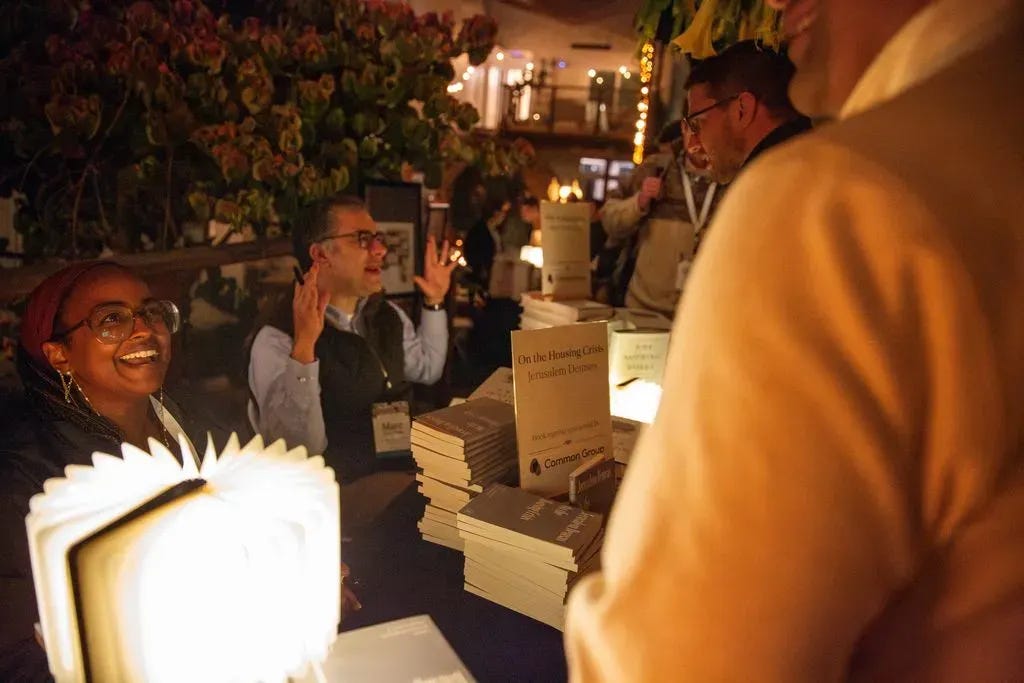
For example, in 2024, Virginia Postrel, one of our initial dozen speakers, asked if we’d buy a couple of dozen copies of her book The Future and Its Enemies as part of having her as a speaker. That’s how our now annual book signing started: her suggestion made me realize that with many authors as speakers, signed books would be a perfect SWAG item to give away. The conference is all about progress ideas, and one of our longer-term goals at RPI is to empower progress intellectuals to build up the foundational ideas of our movement. How great that our guests can take away signed books that are a core part of the bookshelf full of progress books we want to see at bookstores across the country!
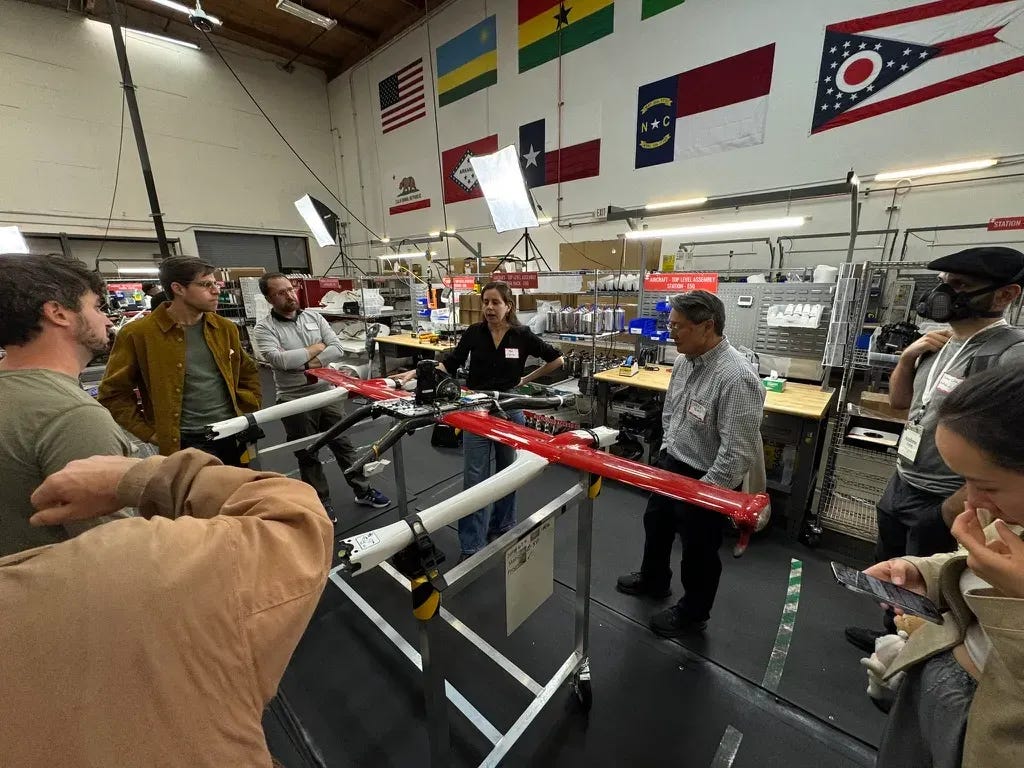
Or take factory tours, new for 2025. A week before the 2024 conference, Keenan Wyrobek from Zipline emailed us, inviting conference attendees to tour their Halfmoon Bay facility. This was too short notice to do anything but just let people know about the invitation—but it seeded the idea of factory tours. This year, we offered eight tours, most of which were at capacity with waitlists. It was easy to say yes: we were clear that we wanted building things—actually creating progress in the real world—to be a central part of the conference, and how better to inspire and energize than to see ambitious founders and teams build cool products?!
In general, once you are crystal clear on your event goals and you understand who your attendees are, it becomes much easier to jump on good-fit opportunities (and to say no to others that won’t fit well). This year, with Ben Thomas joining the team and taking over much of the conference work, we added on-site childcare (we want people from all kinds of stages of life to come), experimented with inviting student volunteers to help with the conference (great fit with the new Students for Abundance network!), had Misha Glouberman host a “meet the right people, fast” opening session, worked with Renaissance Philanthropy to host an event on Sunday where potential philanthropic funders could learn about larger-scale progress projects to fund, and just two weeks before the conference added a romantic match-making event to the Saturday night program. We’ll keep experimenting with new ideas each year, as long as they meet our goals and we think a good share of our attendees will enjoy them.
The impact: a growing Shelling Point event for the progress movement
This is only the second year of the Progress Conference, but it feels like it’s becoming the central event for the progress movement. (We’ve just announced Progress Conference 2026, to be held October 8-11, 2026 in Berkeley, again at Lighthaven.)
Several key progress organizations have been co-hosting the event, and taking active roles in making it great, such as Abundance Institute hosting the welcome dinner at Lighthaven, and Works in Progress hosting the speaker & sponsor dinner at Stripe HQ. Other progress-related organizations are sponsoring the conference and hosting adjacent events before, during, and after the conference.
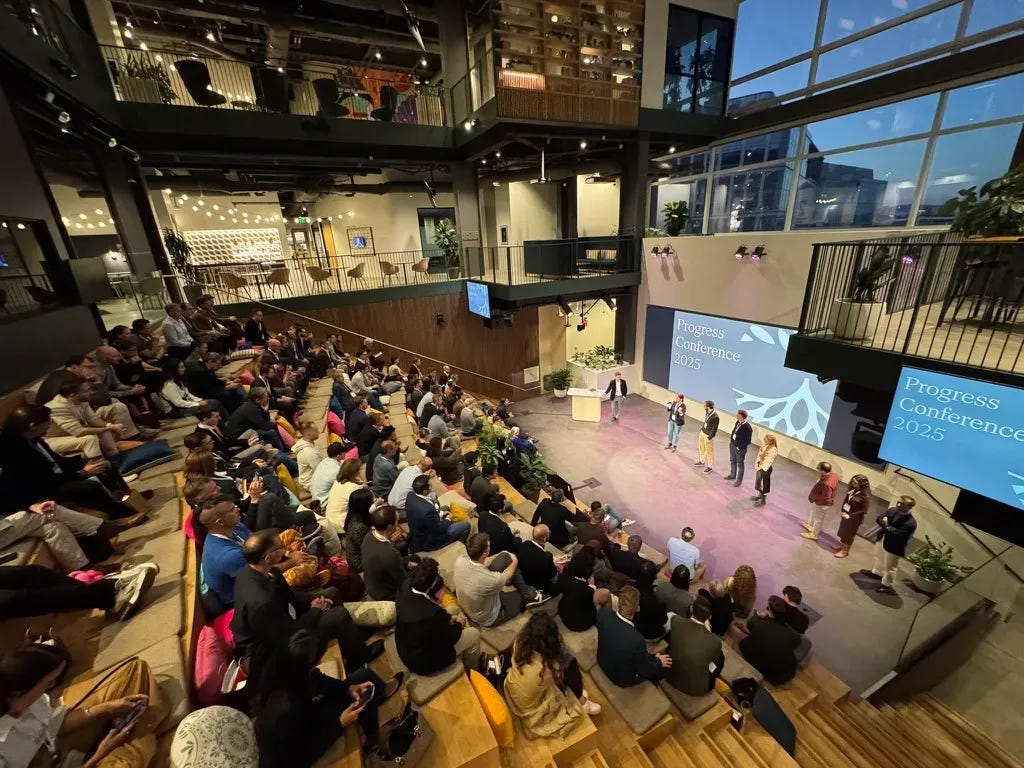
This year, we received more requests to speak than we had speaking spots available. With the support from Big Think, a media organization central to the progress movement, those not able to attend the conference in person will be able to watch most of the talks in video form; Big Think has also just published a special issue on the occasion of the conference, synthesizing insights from the speaking tracks reported by some of our Roots of Progress fellows, and featuring essays by some of the speakers and other guests.
Most importantly, the conference is a place where people eager to make progress happen can gather, meet each other, ideate new projects, and leave energized to do the work to make progress real. We learned that this type of event is hugely valuable: our feedback survey showed a Net Promoter Score of 83, which apparently is “world class”—and we now know that there are several hundred more people who would be great attendees than the venue capacity of about 350-400.
Our goal is to keep upping the quality of this event next year, and to think about what other ways we can broaden access so more people excited about progress can actively participate in the progress community.
If you are planning an event for a company or a community, or any other larger group of people, I hope this post is somewhat helpful. Ben Thomas, RPI’s Event Manager who is now in charge of the conference, and I are also happy to get on a quick call and answer questions, paying forward the help and support we received from so many when we first set out to plan the first conference in early 2024.
Such a clever title! And a truly excellent conference that makes my entire year.
Heike (and Emma, Jason, Mike, Ben), thank you so much for countless hours of deep thought y’all put in every aspect of your programming. I feel so lucky to know and get to interface with intentional people. It’s been the best part of my day for the past five months!